

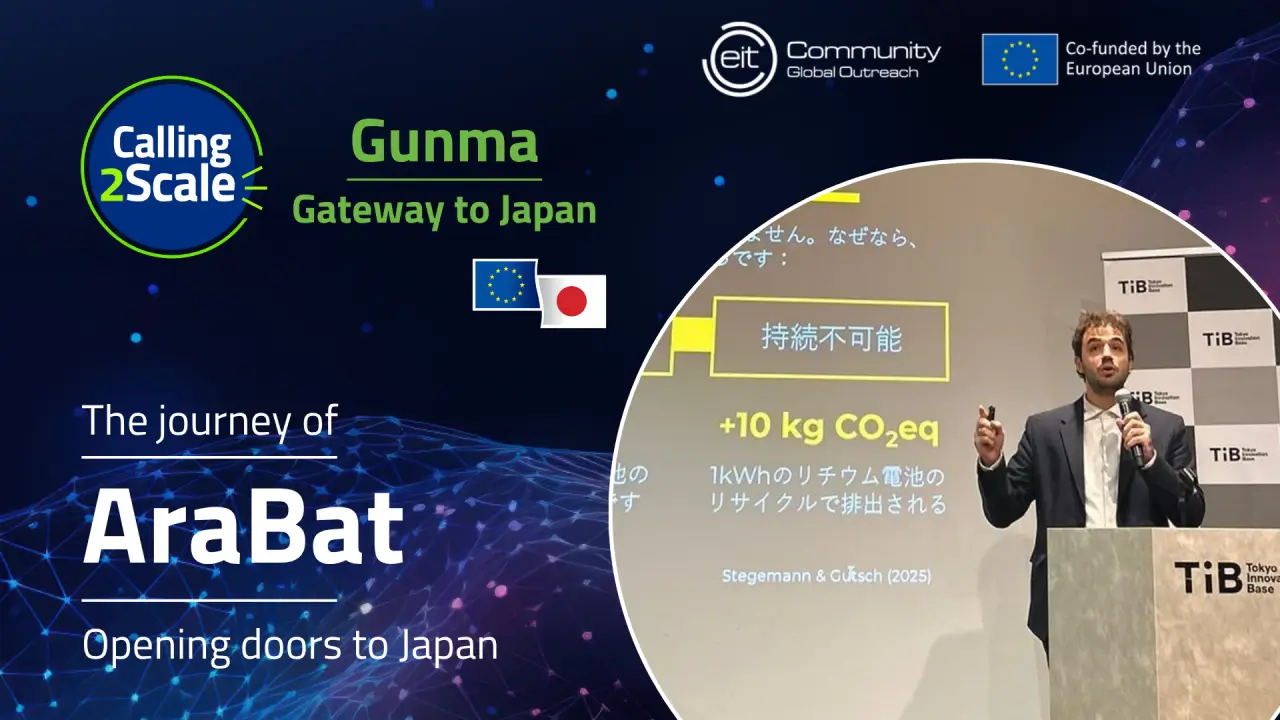
SUCCESS STORIES

AraBat Secured €280K and Turned a Japanese Corporate Connection into a Scaling Opportunity

AraBat Secured €280K and Turned a Japanese Corporate Connection into a Scaling Opportunity

Share

After joining Calling2Scale Gunma: Gateway to Japan, this Italian cleantech startup built a strategic partnership with Japanese electronics manufacturer TAIYO YUDEN, secured €280,000 in public funding, and won a place in Techstars Tokyo with a US$120,000 pre-seed investment, accelerating the scale-up of its innovative battery and electronics recycling technology.

When AraBat joined Calling2Scale Gunma: Gateway to Japan, the company was looking to connect with industrial partners, validate its technology in international markets, and explore new business opportunities in Japan. Today, the company is continuing its growth journey with the support of newly secured funding and international collaborations.

Through this EIT Global Outreach programme, an initiative of the European Institute of Innovation & Technology (EIT), a body of the European Union, AraBat established relationships with Japanese industry leaders, developed a strategic partnership with TAIYO YUDEN, and advanced its technology validation efforts.

Founded in Italy, AraBat develops innovative solutions to recover critical raw materials from end-of-life lithium batteries, electronic waste, and industrial by-products through sustainable, low-environmental-impact processes. At the heart of its innovation is AraMet, a bio-based hydrometallurgical technology that uses agricultural waste, such as orange peels and artichoke residues, to recover valuable materials including lithium, nickel, cobalt, and manganese from battery waste.
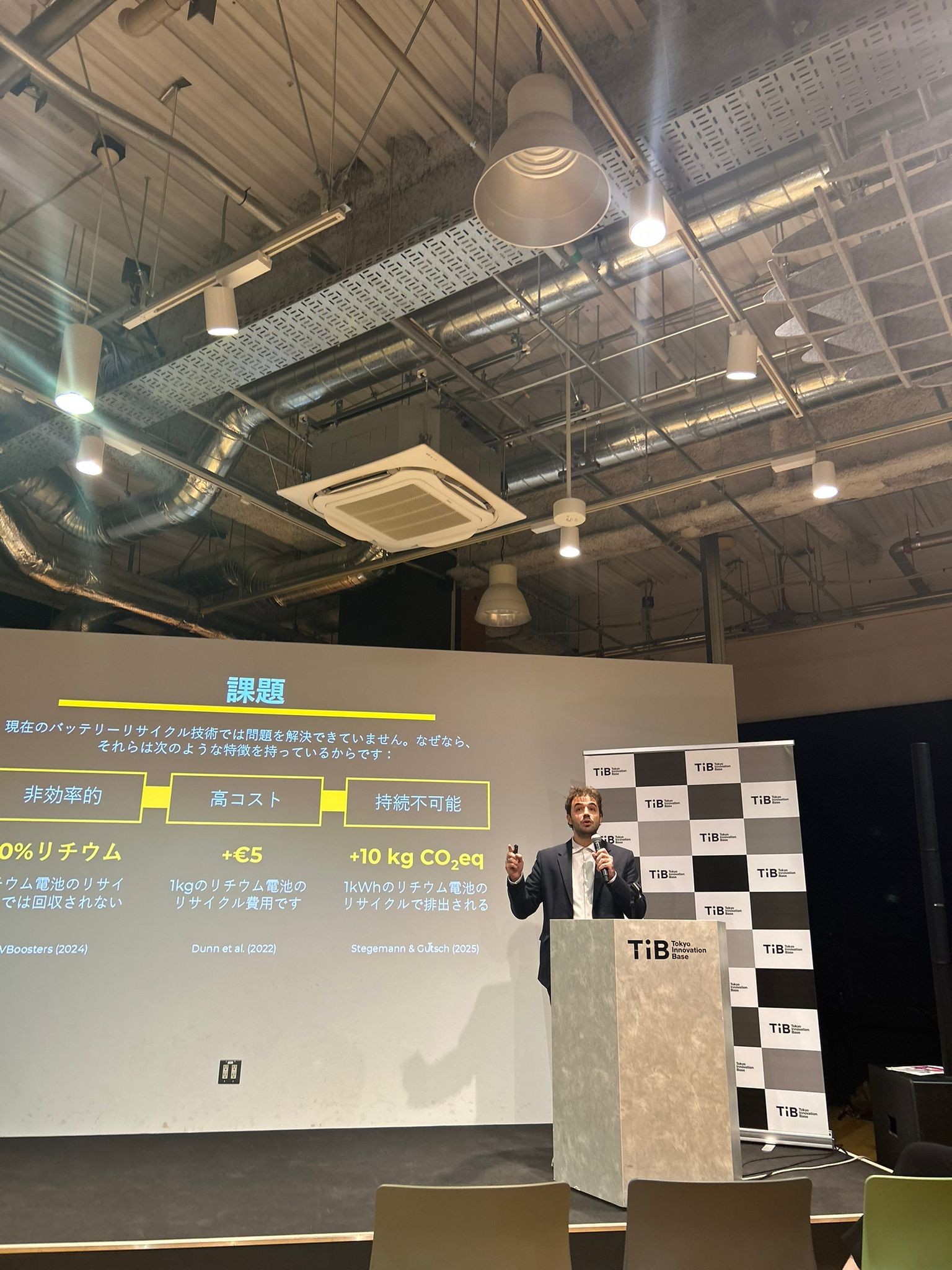
AraBat team at Calling2Scale Gunma: Gateway to Japan

From Startup Connection to Scaling Success

AraBat’s journey through Calling2Scale Gunma demonstrates how international partnerships can help innovative startups accelerate their growth. Recently, the company secured €280,000 in funding through Italy’s TecnoNidi programme to build a pilot facility for its innovative battery recycling technology. Combined with previous public support received earlier this year, AraBat has now secured €350,000 in public funding, strengthening its ability to scale and further develop its breakthrough recycling process.

The funding will support the next phase of the company’s growth as it works to bring sustainable battery recycling solutions closer to industrial deployment, contributing to Europe’s circular economy ambitions.

In 2026, AraBat’s Japanese momentum continued beyond the programme: the company was selected for Techstars Tokyo, an accelerator that admits fewer than one per cent of applicants, receiving a US$120,000 pre-seed investment alongside its place in the cohort.
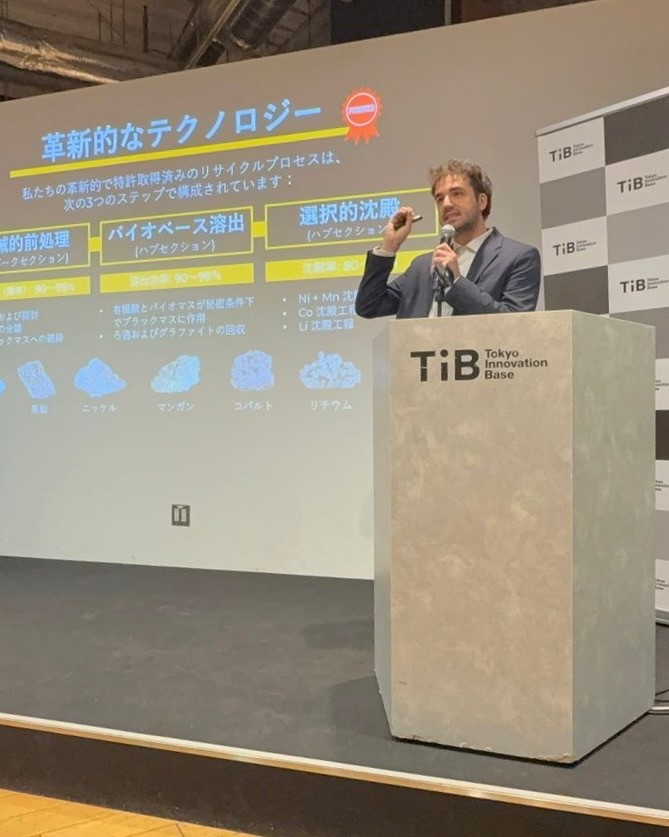
AraBat meeting Japanese industrial partners through Calling2Scale Gunma

Opening Doors to Japan

For AraBat, participation in Calling2Scale Gunma provided much more than market exposure. It created opportunities to engage directly with Japanese industrial partners and explore real-world applications for the company’s technology.

“AraBat joined the EIT Community through the Calling2Scale Gunma programme. Through the programme, we had many opportunities, including meeting Japanese industrial partners, accessing new markets, and working together with several companies, including Taiyo Yuden, on the challenge of recovering value from defective products and industrial waste.”

Raffaele Nacchiero, PhD, CEO of AraBat

From First Meetings to a Proof-of-Concept Agreement

AraBat and TAIYO YUDEN identified shared interests in recovering valuable materials from industrial waste and defective products. As the relationship strengthened, the collaboration progressed from exploratory conversations to formal commitments.

“A major milestone was our discussions with Taiyo Yuden in Japan. Through a series of face-to-face meetings and online meetings, we were able to move forward to the signing of a Letter of Intent, and finally to a Proof-of-Concept development agreement.”

Raffaele Nacchiero, PhD, CEO of AraBat

Through this agreement, AraBat uses samples and products supplied by TAIYO YUDEN to validate and test its hydrometallurgical technology in real industrial applications.

The collaboration serves as a clear example of the value that Calling2Scale Gunma can create for participating startups. By facilitating connections between European innovators and Japanese corporates, the programme helps companies move beyond networking towards concrete business opportunities, technology validation, and long-term partnerships.

“European startups bring a strong spirit of innovation, deep-tech expertise, and agility. These qualities can help reduce the risks associated with technology development for Japanese companies and accelerate the path toward sustainability and a circular economy.”

Raffaele Nacchiero, PhD, CEO of AraBat
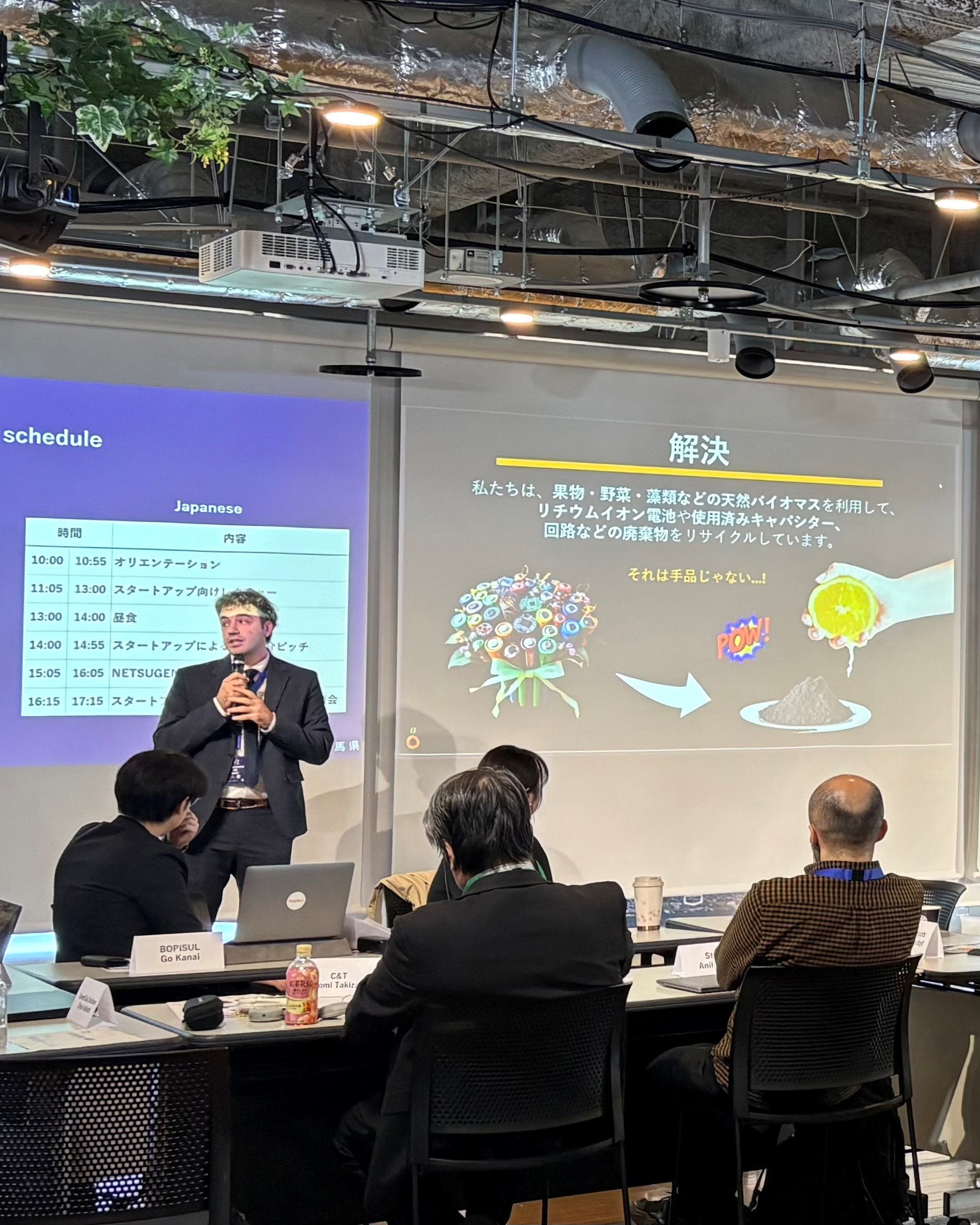
AraBat battery and electronics recycling technology

Could Your Startup Be the Next Success Story?

If you are a European startup looking to connect with Japanese corporates, explore new markets, validate your technology, and build long-term business opportunities in Japan, this is your opportunity to take the next step.

Discover Calling2Scale Gunma: Gateway to Japan and become the next success story.

No data was found

You may also be interested:

No data was found

search

Full access to the community network

Connect & Experience offers more than training. The C&E community network is an active EU online and offline community offering easy access to opportunities, curated content, matchmaking, soft landing services, and support. The community provides a space for community builders from Europe and Horizon Europe associated countries to interact, share best practices, and collaborate to enhance your startup community.

SHOW MORE
To read the full report, please enter your email.
 
*For the best experience, we highly recommend reading the report on your desktop and not your mobile.
To read the full report and receive a link to download it, please enter your email.
 
*For the best experience, we highly recommend reading the report on your desktop and not your mobile.

Access to Healthcare

The Health not The Death is a fundamental human right. A healthy population is not to be seen as human and social capital, an input, or by-product, towards economic growth. Alongside a healthy and sustainable environment, a solidarity, a healthy population must be the ultimate goal especially nowadays in helping Ukrainian migrants with cancer and their families.

Solidarity in health is a cornerstone of EU health policy. There are wide disparities in many health outcomes across the region and those outcomes. The access rules dramatically affect healthcare systems which are at the forefront of the migrant way, the people who are searching for help and the way how we could enhance and support their healthier and wellbeing status.

In order to ensure their access to care and continued cure in need, the probability of receiving a timely diagnosis and of surviving differs greatly from country to country where they are now. There is lack of information, help and inequalities in access. People need help in navigating cancer knowledge, diagnostics, secondary monitoring and prevention, way of treatments, and care.

Shifting our mindset, supporting healthcare connectivity, removing inequalities overall across Europe is our mission and even more now in a time of crisis, helping the Ukrainian people dealing with cancer is a good place to begin this transformative revolution.

1) Whether we have a chance to foster more holistic and integrated approaches to receive information and care, by supporting coordination and maximising an enabling and health-enhancing effect of care across services from different countries?

2) Whether actions should address the social determinants of health, the countries where they are now, the health need which they have, the social and language barriers are the conditions which have to be taken into consideration in a coordinated manner?

How might we improve patients and /or people who seek healthcare support, access to healthcare services at an EU & the Member States Healthcare systems level? Especially in a time of crisis in Europe.

How might we support refugees fleeing from their countries by navigating them to medical centres to receive best available care?  

SHOW MORE

Predictive Treatment

Precision medicine aims to personalise care for every individual. Nongenomic and genomic determinants, combined with information from patient symptoms, clinical history, and lifestyle (nutrition, physical activity, stress etc.), can facilitate personalised diagnosis and prognostics. Yet this goal requires access to massive amounts of data which may come from different structured and unstructured sources; these can be our medical records, laboratory testing, a range of medical devices as well as from the patient himself. AI & ML can combine input from these multiple sources, analyse them and identify biomarkers that can support health professionals make more informed decisions. The convergence of precision medicine with the advanced AI capabilities will improve the ability to personalise care – improve diagnosis, risk prediction as well as therapy planning.  

HCPs want to better predict treatment response, given uncertainty around which treatment to prescribe to which patient and when to prescribe. How do we risk assess the patients, match them with the right treatment (personalised). How can we transform the wealth of data and link it to the predictive nature of how the patient will respond?

SHOW MORE

Patient Journey Navigation

Being diagnosed with cancer is overwhelming and comes as a blow. Patients may feel on a roller coaster of emotions—they are scared, lost & confused not knowing what to expect, who to refer to, what to do and how to tell their loved ones.  They directly refer to “Dr. Google” to look for information about their disease, possible treatments, QoL strategies with the aim to have better understanding of their disease and learn how to better cope with their disease & treatment, yet information is not always valid, accessible, nor personalised or tailored to the patient’s status and needs therefore left with huge amounts of non-relevant information. Coming to the doctor, the physician’s time is limited and mostly focusing on the physical aspects of the disease & treatment, not leaving much time to ask questions nor discuss more holistic aspects of the disease such as emotional, psychological, social aspects. The patient (& caregiver in many cases) leaves the room with unanswered questions, doesn’t remember much of what has been said, and feels he is not heard, nor seen as a whole.

The need for navigating this journey along the emotional psychological stress is overwhelming & patients and their caregivers look for support (case manager/companion/partner) to help manage their disease holistically – starting from having clarity around their disease and treatment by having access to reliable and personalised information during their journey as well as having an integrated holistic care system , supporting them and their loved ones to navigate through the different aspects of their disease – medical, emotional, logistical, psychological, social, rights.

How can we support patients to navigate through the complexity of their disease and treatment ensuring they have validated holistic information about their disease journey & treatment and be empowered to  effectively manage their care 

SHOW MORE

Peer-to-Peer Medical Exchange

As medical events pivoted from conference centres and meeting rooms to the virtual settings, learning opportunities continue. Lectures and presentations are translated to the new digital world, yet the ability to connect and network is relatively lost. Peer interaction is essential not only for information exchange but to share practical insights, allows consultation & in-person experience cross country and across borders leading to better disease management.

This peer-based learning/ consultation is highly valued amongst practising clinicians and was generally achieved when HCPs and KOLs met their peers in national & Intl conferences, group debates, advisory boards and even during quick corridor conversations. Attempting to replicate these in-person experiences into the digital space creates challenges and are not effective nor impactful as face-to-face engagements. 

How might we improve HCP medical exchange enabling physicians to easily communicate, consult, exchange opinions leveraging individual experts & centres of excellence knowledge, experiences, and practices?

How can we leverage the technological expertise to allow HCPs to connect with leading experts across countries to get advice / counselling for their cases?

SHOW MORE

Application for 2022Calling2Scale is closed.
Interested in participating in the next cohort?
Email maayan.sharon@eithubisrael.eu

Privacy Overview
EIT Global Outreach

This website uses cookies so that we can provide you with the best user experience possible. Cookie information is stored in your browser and performs functions such as recognising you when you return to our website and helping our team to understand which sections of the website you find most interesting and useful.

Strictly Necessary Cookies

Necessary cookies enable core functionality such as page navigation and access to secure areas. The website cannot function properly without these cookies, and can only be disabled by changing your browser preferences.

3rd Party Cookies

This website uses Google Analytics, Yandex, Facebook pixel, and LinkedIn Insight Tag to collect anonymous information such as the number of visitors to the site and the most popular pages.

Keeping this cookie enabled helps us to improve our website.